Showing posts with label ordinary time. Show all posts
Showing posts with label ordinary time. Show all posts
Sunday, August 23, 2009
Sermon - The World Would be a Better Place if Everyone Was Naked!
Preached on my 6th day on the street. Click the triangle above to play. If you don't see a triangle find the sermon at www.sermon.net/sfwelcome
Date: 08-23-2009
Description: A sermon preached at the 8:30 Contemporary service at Salem English Lutheran in Minneapolis.
Key words: homeless,HIV/AIDS,health,justice
Pastor : Megan Rohrer
Sermon : Salem English Lutheran - Minneapolis
Scripture : John 6:51-66


Sermon- Really, Really, Really, Really
Preached on my 6th day on the street. Click the triangle above to play. If you don't see a triangle find the sermon at www.sermon.net/sfwelcome
Date: 08-23-2009
Description: A sermon preached at the 8:30 Jazz service at Salem English Lutheran in Minneapolis.
Pastor : Megan Rohrer
Sermon : Salem English Lutheran - Minneapolis
Scripture : John 6:51-66
Monday, October 6, 2008
many are called, but few are chosen
Matthew 22:1-14
What a seemingly strange text. Many are called, but few are chosen? What does this mean in light of Jesus' proclamation in Matthew that the poor and sex workers will go ahead of you to heaven. Will they only then be kicked out for not having the proper clothing?That's a hard pill to swallow, unless it is a metaphorical understanding that we are called to be clothed in Christ. Even then, Jesus' own words that there will be others in heaven and with him that we would not expect would lead me to believe that this text is in tension with Jesus' calls for inclusion. Last weeks entry speaks more about that.
How can we believe that many are called, but few are chosen and still believe in the priesthood of all believers?
Some of these questions can be answered by nuances in the greek meaning of the word many. I had always read the many to mean the final group of people that came to the party. Yet, in the greek the word "many" is the equivalent to "all." All were invited but only a few bothered to show up or do what they ought. This is talking about the entierty of the story, not just about the last group that showed up. This new reading suggests that all are invited, and we are the ones who need to respond appropriately.
Yet, as a Lutheran pastor, I would not want you to think that I am saying that we are justified by our works.
While this passage may lend itself to the reading that if you do the right things you will have life and get to party with God(dess), I believe the deeper meaning comes from not splicing this text from the rest of Matthew. It is very fitting in Matthew's text that the poor would be the ones to overwhelmingly respond to the call. My concern with the one member of the lower class that is killed, caused me to forget that 100% of the upper class got it wrong.
Isn't that always the way that people, like me in this case, remember the slight of the poor more than the slights of the upper crust. Perhaps some people. Or, it could be that so much of my work is about making sure every person, regardless of their socioeconomic class gets fair and equal treatment, that I am just responding to my call to speak out for the poor.
No, we couldn't have expected the poor person to show up in the right outfit. Yes, it is better that he atleast made the effort to show up (probably knowing he would be killed). But, you and I both need to care equally for those in the highest offices as we do for those sleeping on the lowest sidewalks (and the otherway round).
This text teaches me my own biases. That's the point. No matter who we are rooting for. We are not only equal in our sinfulness, we are equal in our sense that our neighbor isn't getting their fair due (good or bad). We are the hands that need to be working to maintain God(dess) justice (Isaiah 56) and/or reminding God(dess) of the justice that has been promised, but is woefully overdue!
We've got work to do. It want save us, but we are all called nonetheless.
Proper 23A/Ordinary 28A/Pentecost +22
Monday, September 29, 2008
God(dess) Gathers the Outcasts
Matthew 21:33-46
This is a very bloody parable indeed - well that is if you take it only as it is written here in Matthew. Surely Jesus and those who talk about this story were well aware that it is actually an illusion to a very well known story in Isaiah 5.And surely if everyone in the conversation knew that Jesus was talking about the story in Isaiah, they would have also known that in the very next Chapter God(dess) sends a prophet to come and remind people that they are to maintain justice and care for the poor and widows. This is the same work Jesus was doing. While and strange and bloody way to say it, Jesus is using the Jewish stories that he loves to proclaim that he is a prophet who has come to bring justice for the poor.
The Good News is that we are not being called to plan, lobby or create new ways to make the world more just. Isaiah 56, calls us to: "Maintain justice, and do what is right, for soon my salvation will come, and my deliverance be revealed."
Did you notice the word "maintain"? God(dess) has already established justice, it is our job to maintain what God(dess) has done/declared. More bluntly, it's our job to try not to screw up G0d(dess)'s justice. This is much different than asking ourselves: What am I doing to create justice in the world? Instead we ought to ask ourselves: What we are doing to oppress others, to prevent our neighbor from having their daily bread or from being able to walk a step closer to God(dess)
I wonder how the world would change if we tried to work on our own inner oppressor. Namely, if we stopped judging others and telling them how they should be more just, and we work on being more just ourselves. This is afterall the true path to nonviolence.

Of course the story doesn't end there. Isaiah 56 says this is exactly what God(dess) is doing, by revaluating the ways God(dess) is oppressing others. In verse three it says: "Do not let the foreigner joined to the Lord say, 'The Lord will surely separate me from [God(dess)'s] people'; and do not let the eunuch say, 'I am just a dry tree.'"
This text is specifically talking about those the scriptures say are cut off from God(dess). Here God(dess) reverses course and declares they are in fact NOT separated from God(dess). This models the transformation in the book of Hosea when "Not my people" become "My people" and is also repeated in Ruth's love song to Naomi.
While used more broadly in other texts, here in Isaiah 56 it is explicetly tlaking about about the eunuchs, transgender individuals and those who are gay, lesbian, bisexual and queer. It means that none of these groups should have to prove they are worthy of God(dess)'s love because of how they love or transform their body. Rather all other Christians ought to be reaching out to them and giving them pastoral care and sharing words of grace with them to remind them that they are not seperated from God(dess).
It seems we've gotten it all backwards these days! Isaiah is clear God(dess) is more concerned with our faithfulness and our desire to maintain jusitice.
And though it is through the lens of Isaiah that we can understand Christ, this week's Matthew text is just one more of the many times that Jesus is proudly proclaiming the "the Lord God[(dess)], who gathers the outcasts of Israel" and proclaims that G0d(dess) "will gather others to them besides those already gathered." (Isaiah 56:8)
Proper 22A/Ordinary 27A/Pentecost +21
Tuesday, September 23, 2008
By whose authority?
Matthew 21:23-32
By whose authority? I get asked this question a lot while I'm on street retreat, while I'm working at the church, by people who wonder why I'm in the men's bathroom, or who wonder how I can wear a clergy collar and have breasts. The easy flip answer is that nothing I can do can ever separate me from the love of God(dess) and I am called to sin boldly.But underneath that flip answer is probably the much more honest, much more human: "by my own authority."
It would of course be more fun to say with solid certainty that I am acting on God(dess)'s authority. But I can't. Yes, I know it's ironic that it is my full time job it to share the word of God(dess) and to admit that I can never be sure that I know the word of God(dess).
This is not lack of faith, rather it is a constant wrestling and yearning to continually ask myself if my actions follow the will of God(dess). This acknowledges that God(dess) may call me to do something for God(dess)'s sake that seems to go against the written word of God(dess). As Dietrich Bonhoeffer discovered, when he found himself called to participate in a plot to assasinate Hitler, despite knowing that it was against God(dess)'s commandments to kill.
It may seem unusual to some that Jesus tells the faithful that the tax collectors (known for being violent and often unfair) and the prostitutes (who persuade people to covet and commit adultery) will go ahead of them in heaven. In fact, Jesus says that the sex workers will be first in heaven more than any other group. Perhaps this is because those who are the most vulnerable and stand in the widest intersections of oppression tend to have God(dess) in their gut in a way that others can never truly understand.

This is why the Exodus texts talk about the vulnerability of the wilderness. If the only stable thing you have in your life is God(dess), or you really are praying mightily each day for your daily wage, daily bread or daily water - then you get faith in a different way. It's not better, it's just more from the gut and less from the brain or book of confessions.
This may explain why Jesus never answers the question. How can someone living from their gut, answer from their head. If you know deeply in your bones that you are called by God(dess) to do something, or when working for justice seems so clear that you could do no other, why would you stop to bother to answer questions of authority.
By whose authority? How could you ask such a question when it is so clear that people deserve homes and food and water and a name and dignity and hope and life.
Proper 21A/Ordinary 26A/Pentecost +20
Thursday, September 18, 2008
Whiners get Bread from Heaven? I will Go and Do Likewise!
Exodus 16:2-15
What is the lesson from this text? Can it really be that if you whine to God(dess) you will get what you want? Perhaps. Lutherans believe that we always get more from God(dess) than we deserve - this is grace.
While there is a part of me that cautions against the simplistic understanding that if you pray for things you will get them like a genie waiting to provide wealth and fortune, if you but believe. While I do have had powerful experiences in my own life and in those I love of times when prayer heals bones, mends broken lives, heals addiction and other diseases, I also know a number of very faithful people who have prayed mightily and have not found relief from what plagues them.
It is too easy to say just pray harder, or that prayer doesn't work if you don't believe "enough." My Lutheran charisms always remind me that I am never "enough" for the "more than enough" that I get from God(dess).
I think this text and many of the angriest Psalms give us a better idea than prayer. Our God(dess) promises to be for justice, and yet sometimes we need to yell, scream and whine at God(dess) to help God(dess) remember and honor those promises.
This means we need to be yelling, screaming, whining advocates for justice on earth, not only in our prayer lives, but in our sermons, our letters and our interactions with those in power.
The Exodus text tells us that we must whine as we advocate to end hunger (our own and our neighbors).
If you pair this reading with the Philippians (1:20-30) we have good reason to believe that this whining, screaming and yelling can also be applied to our physical needs, our health and wholeness in our bodies. Certainly, the physical distractions that make it hard for people to be able to think, pray and advocate for themselves are issues that we need to care about as Christians if we want to help are neighbor be able to live a life that is worthy of the Gospel.
Note that I arguing that we make it possible for others to live the life they believe is worthy of the Gospel. I am not saying that we need to tell our neighbor what that means for them. As a community of faithful we can hold each other accountable, but ultimately we are better off when others have freedom (free for and free from their neighbor).
Lectionary Cycle B: Proper 20A/Ordinary 25A/Pentecost +19
Wednesday, September 10, 2008
more than ammunition for a sling shot
Romans 14:1-12
This text has the obvious message that we should not judge our neighbor. But even more to the point, it urges us to be glad that our neighbor (who may be acting in all sorts of ways that we would not approve of) is in the care of God(dess). This text is more than ammunition for a sling shot for the powerless to sling at those with power and privilege. It calls us all to respect the faith of the "other."This is why I always ask those who try to tell me about how my life sits in the eyes of God(dess) to pray for me. I can't know what they pray for when they pray for me. But still, I seek to honor their faithfulness to God(dess) and to recognize our kinship.
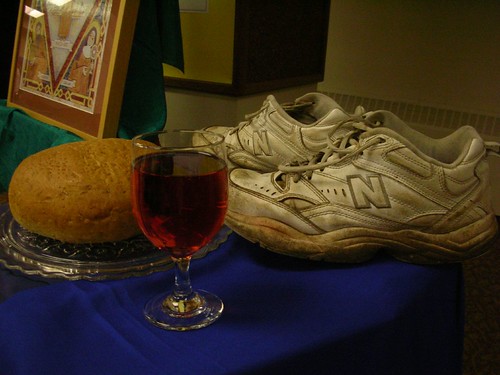
My work is to continue to remove the barriers that prevent all people from sharing the same communion table. Sometimes this means taking the bread (or the crumbs) from the table, outside church walls to all who are hungry. Othertimes it means restraining my tongue and my judgements, so that even those who I disagree with the most strongly can see my table manners and eat with me.
Lectionary Cycle B: Proper 19A/Ordinary 24A/Pentecost +18
Monday, September 8, 2008
By any other name...
Matthew 18:21-35
Certainly, this text calls us to remember that we are all equal in our need for forgiveness. Beyond that, it also reminds us that the road for one is not the same road for all. God(dess) calls some to be pastors, some to be construction workers, some to be parents, some to be queer, some to be single.For some people, bisexuality is a part of their journey towards identifying as gay or lesbian. For others it is their identity. For some, being in a space of gender non-conformity is a step on the path to a more gender conforming space. And for others gender non-conformity is their identity.
Sometimes we want others to feel the same relief that we felt when we were able to identify in a way that brought us understanding and fuller sense of self. Sometimes our desire to share what worked for us, provides a road block for others who are seeking that same privilege to self identify.
Whether you are someone who has felt the blessing of being named and claimed by God(dess), experienced the joy of claiming a new name or someone who has taken for granted the privilege of naming your self, please give other people the gift of naming themself, their identity and their gender pronouns.
Before I was born, my name was Ryan. In those days they determined the sex of a baby by listening to its heartbeat. And in my heart I was a boy. When I was born, the first words uttered were "opps," because when the doctor saw the skin between my legs he forgot what my heart had told him. For three days I was called, "baby girl Rohrer." Then my parents named me "Megan."
I don't believe what that doctor said. My birth was not an "opps" and either were any of my names. Now, I go by Ryan or Megan, acknowleding that my heart and the folds of my skin tell two different stories.
Our bible is full of stories about names. You can tell so much about someone by their name. There are many stories in the bible that also tell the story of how interacting with God(dess) changes people (and their names).
What is the story of your name? What are the names in the bible that speak to you?
Prayer: Psalm 103
Lectionary cycle B: Proper 19A/Ordinary 24A/Pentecost +18
Friday, August 22, 2008
Extra-Ordinary Time
As a pastor called to four very diverse congregations (St. Francis, HerChurch, Christ Church and Iglesia de Santa María y Martha), I do a lot of preaching in different contexts, with different names for God(dess), with different liturgy, and different cultural and socioeconomic backgrounds.
I also find myself sharing with a diverse group of people in this motley city of Saint Francis the answer to the question "what did you preach about today?" And I'm always surprised to find how different my take on the text tends to be from what people expect from a pastor.
My mom told me that if the Bible was translated the way I tell the story that churches would be packed. Perhaps this is because I have a special ability to tell the story that is written between the lines in a flip yet reverent manner that can be poetic and disarming. Or perhaps its because its because of the unique worldview I have from speaking with, to and for so many diverse folk.
So, I've decided to place some of my thoughts about the texts and how they speak to me in this blog space. Hopefully it will speak to the flip yet reverent spaces inside of you. Perhaps it will help you see a text from a new perspective.
You should remember that as a pastor, sharing the Good News of God(dess) is my passion and life's work. So, please read my deep engagement with the text as a deep wrestling of someone who is deeply committed to faith and learning about God(dess)' inter-acting with(in) this crazy and beautiful world that is already the not yet (like me and you).
Here are some brief snippets of the texts as I have seen them so far this summer:
Jesus/Christ-Sophia literally says don't worry about what you eat it just becomes poop. Why are you focused on poop when you should be thinking about what comes out of your heart?
Then, he immediately misses his own point and calls a women a b**** (the greek is the female version of the word dog which in english translates to a swear word), who asks him to heal her daughter because she is of the wrong race (ie not a Jew). The woman, retorts to Jesus within his patriarchal language and causes Jesus to change his mind. Though, he still calls her "woman" rather than learning her name - as happens when men ask to have their children healed - he does end up doing what he ought.
While originally I thought that this text was just another example of misogyny (which it is) that either came from Jesus or those who wrote the text, I came to see how subversive it is to have this story remain in the text. This text highlights Jesus' humanity. It shows even he has a hard time following his own advice. And it shows that even those that God(dess) insults are still able to get justice when they, like the prophets of old, remind God(dess) of the promise to protect and save God(dess)' people. And it shows that (like in life) a racist and misogynist character usually has a lot to learn from the person they are putting down. [Sermon preached at Herchurch in San Francisco]
 I believe that we should listen to our bodies. The fear we feel is important and it teaches us. It helps us stay safe when we are potentially in danger. It helps us to take care of the things we ought to, like getting earthquake readiness kits, insurance and following stop light signals. Though being cautious doesn't always mean that bad things won't happen.
Listening to our fears also teaches us when we need to learn something new or shows us where we have prejudices that we need to take a look at. But if we ignore our fears, we will never take the opportunity to notice that we are afraid of people that are not like us.
Do we have different rules in our churches for people who are of a different socioeconomic class, race, membership status, etc? Are these fears helpful?
And if it is true, as the Gospel of Matthew claims, that Jesus is in the stranger, the hungry, the homeless, then are we creating rules in our church that keeps us away from God(dess)? Do the fences around our churches and locked doors keep what is sacred in or out?
Yes, we can do unexpected amazing things, beyond our expectations. But we have to go outside our churches, our boats and our comfort zones in order to do it. [Preached at HerChurch and St. Francis]
I also find myself sharing with a diverse group of people in this motley city of Saint Francis the answer to the question "what did you preach about today?" And I'm always surprised to find how different my take on the text tends to be from what people expect from a pastor.
My mom told me that if the Bible was translated the way I tell the story that churches would be packed. Perhaps this is because I have a special ability to tell the story that is written between the lines in a flip yet reverent manner that can be poetic and disarming. Or perhaps its because its because of the unique worldview I have from speaking with, to and for so many diverse folk.
So, I've decided to place some of my thoughts about the texts and how they speak to me in this blog space. Hopefully it will speak to the flip yet reverent spaces inside of you. Perhaps it will help you see a text from a new perspective.
You should remember that as a pastor, sharing the Good News of God(dess) is my passion and life's work. So, please read my deep engagement with the text as a deep wrestling of someone who is deeply committed to faith and learning about God(dess)' inter-acting with(in) this crazy and beautiful world that is already the not yet (like me and you).
Here are some brief snippets of the texts as I have seen them so far this summer:
Matthew 15:10-28:
Jesus/Christ-Sophia literally says don't worry about what you eat it just becomes poop. Why are you focused on poop when you should be thinking about what comes out of your heart?
Then, he immediately misses his own point and calls a women a b**** (the greek is the female version of the word dog which in english translates to a swear word), who asks him to heal her daughter because she is of the wrong race (ie not a Jew). The woman, retorts to Jesus within his patriarchal language and causes Jesus to change his mind. Though, he still calls her "woman" rather than learning her name - as happens when men ask to have their children healed - he does end up doing what he ought.While originally I thought that this text was just another example of misogyny (which it is) that either came from Jesus or those who wrote the text, I came to see how subversive it is to have this story remain in the text. This text highlights Jesus' humanity. It shows even he has a hard time following his own advice. And it shows that even those that God(dess) insults are still able to get justice when they, like the prophets of old, remind God(dess) of the promise to protect and save God(dess)' people. And it shows that (like in life) a racist and misogynist character usually has a lot to learn from the person they are putting down. [Sermon preached at Herchurch in San Francisco]
Matthew 14:22-33:
Jesus/Christ-Sophia tells the fishermen not to be afraid. Yet, fishermen are probably not afraid very often on the sea, and if they are it probably helps them have the adrenaline they need to take a situation seriously. People often preach that we should not be afraid if we have enough faith.
 I believe that we should listen to our bodies. The fear we feel is important and it teaches us. It helps us stay safe when we are potentially in danger. It helps us to take care of the things we ought to, like getting earthquake readiness kits, insurance and following stop light signals. Though being cautious doesn't always mean that bad things won't happen.
Listening to our fears also teaches us when we need to learn something new or shows us where we have prejudices that we need to take a look at. But if we ignore our fears, we will never take the opportunity to notice that we are afraid of people that are not like us.
Do we have different rules in our churches for people who are of a different socioeconomic class, race, membership status, etc? Are these fears helpful?
And if it is true, as the Gospel of Matthew claims, that Jesus is in the stranger, the hungry, the homeless, then are we creating rules in our church that keeps us away from God(dess)? Do the fences around our churches and locked doors keep what is sacred in or out?Yes, we can do unexpected amazing things, beyond our expectations. But we have to go outside our churches, our boats and our comfort zones in order to do it. [Preached at HerChurch and St. Francis]
Subscribe to:
Posts (Atom)