Listen Online I Download
Sermon : Unitarian Universalist Church of Marin
Readings : Bernie Glassman - Bearing Witness
Does God want us to give it all away or to be practical, good stewards who save? What is the appropriate faith response to panhandling? Pastor Megan will addresses these questions and share insights from her eight years working with the chronically homeless and from her street retreats, where she lives on the streets in San Francisco's Tenderloin.
Showing posts with label homeless. Show all posts
Showing posts with label homeless. Show all posts
Sunday, October 3, 2010


Sunday, October 11, 2009
The Rich Young Ruler
Click the triangle above to listen to the sermon. If you don't see the triangle, you can hear the sermon on www.sermon.net/sfwelcome
| Date: | 10-11-2009 |
| Description: | Give all your money to the poor, or keep in for an emergency? The call to be vulnerable. |
| Key words: | poverty,stewardship,mark,jesus |
| Pastor : | Megan Rohrer |
| Sermon : | St. Cyprian's Episcopal |
| Scripture : | Mark 10:13-31; Amos 5:6-15 |
Sunday, July 19, 2009
Sermon: Sheepdog's Tale- Don't Wait for Help
To play click the triangle above.
Date: 07-19-2009
Description: The text is cropped to say that we should all take a vacation, but hunger, health care and the needs of the world can't wait. Jesus' response: You feed them. Learn some ordinary and extraordinary ways you can help with hunger in your community
Pastor: Rev. Megan Rohrer
Congregation: St. Francis Lutheran Church
Scripture : Mark 6:30-34, 53-56; Psalm 23
Monday, July 13, 2009
You give them something to eat!
Mark 6:30-34, 53-56
When the lectionary cuts out an important story in the middle of the text it does a disservice to the story and to those who hear it! Jesus' command that the disciples feed those gathered is an important part of this story. This cut out story seems to be the script that many people have today about why the poor should help themselves. Yet Jesus responds, despite the cost: "You give them something to eat" (v. 37).
Don't argue about how they got here, if they should have planned better, about how much it will cost or if it will split the church. Just feed them!
In much of my work with those living in poverty or who are homeless it has often felt like the obvious thing to do is just staring everyone in the face:
People without homes -- give them homes
people without food --- give them food
people with out clothes --- give them clothes
people without health care --- give them health care
You can see where I'm going with this. And I can hear the questions now: but what if they use it for bad purposes? Or what if they just waste it (after all if they were able to use things appropriately they wouldn't be in this space now)?
Perhaps. But people living in emergency situations, don't have the privilege of time to figure out what your budget should look like, if there is a better way to use the money or the color of the carpet in the room where the service happens.
Perhaps giving people the basic needs that are required for a healthy life may lead some people to be able to make choices we wouldn't condone. But thankfully, when I'm given my paycheck each week no one asks me how healthy the groceries I will buy are or if I will get any exercise this week before they give me my check.

No, we seem to want to control other people choices, but don't want people to control our own choices. If you have money you can choose from so many different types of milk that there is an entire aisle of milk. But, those who do not have money we seek to take away what little choices they do have (for fear they'll make a poor decision).
I happen to believe that giving people the things they need to be healthy is what we ought to do. We can't know or control what people will do with the things we give them. But that doesn't mitigate our very real responsibility to share what we have, with those who have less. And I find that when we do, those in very real need - more often than not- will use what we have shared in appropriate ways.
At WELCOME this is our mission. And we have a huge increase in the number of people who are begging for food right now. Help us to meet the growing need. Jesus commanded us to feed them. If you can please support our work, or volunteer so that we don't have to turn anyone away.
Proper 11B/Ordinary 16B/Pentecost 7
When the lectionary cuts out an important story in the middle of the text it does a disservice to the story and to those who hear it! Jesus' command that the disciples feed those gathered is an important part of this story. This cut out story seems to be the script that many people have today about why the poor should help themselves. Yet Jesus responds, despite the cost: "You give them something to eat" (v. 37).
Don't argue about how they got here, if they should have planned better, about how much it will cost or if it will split the church. Just feed them!
In much of my work with those living in poverty or who are homeless it has often felt like the obvious thing to do is just staring everyone in the face:
People without homes -- give them homes
people without food --- give them food
people with out clothes --- give them clothes
people without health care --- give them health care
You can see where I'm going with this. And I can hear the questions now: but what if they use it for bad purposes? Or what if they just waste it (after all if they were able to use things appropriately they wouldn't be in this space now)?
Perhaps. But people living in emergency situations, don't have the privilege of time to figure out what your budget should look like, if there is a better way to use the money or the color of the carpet in the room where the service happens.
Perhaps giving people the basic needs that are required for a healthy life may lead some people to be able to make choices we wouldn't condone. But thankfully, when I'm given my paycheck each week no one asks me how healthy the groceries I will buy are or if I will get any exercise this week before they give me my check.

No, we seem to want to control other people choices, but don't want people to control our own choices. If you have money you can choose from so many different types of milk that there is an entire aisle of milk. But, those who do not have money we seek to take away what little choices they do have (for fear they'll make a poor decision).
I happen to believe that giving people the things they need to be healthy is what we ought to do. We can't know or control what people will do with the things we give them. But that doesn't mitigate our very real responsibility to share what we have, with those who have less. And I find that when we do, those in very real need - more often than not- will use what we have shared in appropriate ways.
At WELCOME this is our mission. And we have a huge increase in the number of people who are begging for food right now. Help us to meet the growing need. Jesus commanded us to feed them. If you can please support our work, or volunteer so that we don't have to turn anyone away.
Proper 11B/Ordinary 16B/Pentecost 7
Monday, May 4, 2009
Fruit of the Vine
It just feels too easy this week. John 15: 1-8 God(dess) wants us to bear fruit. So be fruity!
Seriously, if we are a part of God(dess) and God(dess)' work there is no limit to what we can ask for, or what we can expect. This kind of freedom has scared Christians for ages! Doesn't this mean you could commit murder and get away with it. What would our life be like if people used this freedom and disobeyed all those human laws that make our world work.
 Dominic, takes the bible literally. So literally that he ignores the laws of humans and only obeys the laws of God(dess). This means that he crosses the street on the red, walking against traffic and blocking buses. Of course this has come at the cost of his body. He's been hit by cars on more occasions than I could count.
Dominic believes deep down to his toes that we have the resources we need. He spends most of his time in dumpsters reclaiming things that people have thrown away so he can share them with others that need them. Most people see his gifts as trash, but some find what they need.
For Dominic, myself and many other faithful people, it's not hard to ask for what we need (as long as it is for someone else). It's hard to take care of ourselves and ask for what our bodies, minds and souls need.
Yet, God(dess) promises that our fruits will be multiplied. I'm crazy enough to believe, like Dominic that if we all shared more that we would all have enough. The message I need to hear (and perhaps you do too) is that if we accept God(dess)'s gifts for our own care, that God(dess) will use our holistically healthy lives to help others do the same.
So, enjoy a vacation and donate those hotel toiletries to the homeless (at the Welcome Ministry or somewhere close to where you live).
Have a really nice dinner that is good for your body and then donate the same amount of money to a local food pantry.
Take yourself to a spa, and then donate the same amount of money to make sure the poor have access to basic hygenie (public restrooms, showers and socks).
Seriously, if we are a part of God(dess) and God(dess)' work there is no limit to what we can ask for, or what we can expect. This kind of freedom has scared Christians for ages! Doesn't this mean you could commit murder and get away with it. What would our life be like if people used this freedom and disobeyed all those human laws that make our world work.
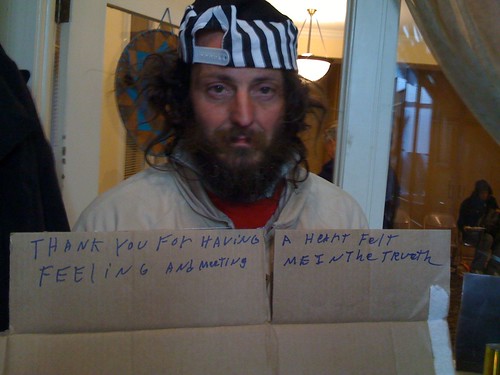 Dominic, takes the bible literally. So literally that he ignores the laws of humans and only obeys the laws of God(dess). This means that he crosses the street on the red, walking against traffic and blocking buses. Of course this has come at the cost of his body. He's been hit by cars on more occasions than I could count.
Dominic believes deep down to his toes that we have the resources we need. He spends most of his time in dumpsters reclaiming things that people have thrown away so he can share them with others that need them. Most people see his gifts as trash, but some find what they need.
For Dominic, myself and many other faithful people, it's not hard to ask for what we need (as long as it is for someone else). It's hard to take care of ourselves and ask for what our bodies, minds and souls need.
Yet, God(dess) promises that our fruits will be multiplied. I'm crazy enough to believe, like Dominic that if we all shared more that we would all have enough. The message I need to hear (and perhaps you do too) is that if we accept God(dess)'s gifts for our own care, that God(dess) will use our holistically healthy lives to help others do the same.
So, enjoy a vacation and donate those hotel toiletries to the homeless (at the Welcome Ministry or somewhere close to where you live).
Have a really nice dinner that is good for your body and then donate the same amount of money to a local food pantry.
Take yourself to a spa, and then donate the same amount of money to make sure the poor have access to basic hygenie (public restrooms, showers and socks).
Monday, April 13, 2009
Street Retreat Blogging
If you are interested in following my experiences living on the streets for 7 days and 7 nights (as I have done for 7 years now), check out: http://www.mystreetretreat.blogspot.com
Monday, September 15, 2008
God(dess)'s Employmnent Non Discrimination Act
Learn more about the Employment Non Discrimination Act
Remember while in today's day this tends to fall down political lines, this text seems to make it clear that Jesus does not believe in a "trickle down economy." Beyond this it seems that God(dess) is also concerned that everyone have to opportunity to obtain their daily wage.
God(dess)'s employment strategy is beyond any non-discrimination policy. Notice that there is no mention of the age, sex, sexual orientation, gender identity or presentation, skill level, mental health status or immigration status. Only a clear understanding that all people require a fair wage - despite their ability to work at equal levels.
 People often say the homeless, mentally ill or disabled are not "entitled" to the same daily wage as others. I invite anyone who thinks that you do not have to work to be homeless, or to obtain social security benefits to sit in a social security office for an hour and observe people. Or check out my blog of my experiences from my yearly street retreat.
Try collecting enough cans from garbage cans to pay for one meal or panhandle $20. Then you will know just a portion of the work that the homeless do on a regular basis. Then imagine accomplishing any of this without a good nights sleep and a sore aching body from lying on a hard concrete bed.
Often the people who are making the smallest amounts of money in the United States are the same individuals who face discrimination each day. How is it fair that those who are doing the most labor intensive jobs, at the lowest hourly rates are also the ones who are experiencing the additional strain of discrimination? Think of what a fair rate of pay would be for the back breaking work of picking strawberries everyday or for unloading a moving van. How much extra should we also pay for the social stigma and discrimination we also make these same workers endure?
Perhaps if people had to pay those they discriminated against they would stop discriminating. But, often those who are trying to rise above poverty or opression often oppress others. This is a lot like the complaining of those who had worked the longest. Is there any wordly way out of this cycle of abuse?
It seems that nothing short of total economic reform in addition to providing daily protection for all is needed. While this may seem overwhelming, we can work one organization, one employer at a time or one city or state at a time.
We need to become people who are honest about our power, honest about our part in economically keeping others down and the ways that we stand in the way of others having their fair wage. Then we need to hire others as we are able, advocate for better daily wages for all and for equal employment opportunities.
Lectionary Cycle B: Proper 20A/Ordinary 25A/Pentecost +19
Matthew 20:1-16
This text provides not only an argument for a minimum wage, one that is based on how much someone actually needs to live rather than hourly amount that people should earn, but it also provides a biblical argument for a maximum wage.Remember while in today's day this tends to fall down political lines, this text seems to make it clear that Jesus does not believe in a "trickle down economy." Beyond this it seems that God(dess) is also concerned that everyone have to opportunity to obtain their daily wage.
God(dess)'s employment strategy is beyond any non-discrimination policy. Notice that there is no mention of the age, sex, sexual orientation, gender identity or presentation, skill level, mental health status or immigration status. Only a clear understanding that all people require a fair wage - despite their ability to work at equal levels.
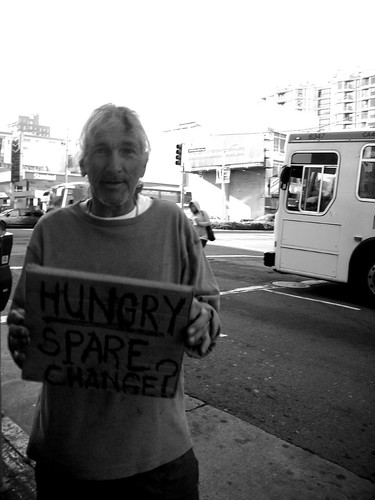 People often say the homeless, mentally ill or disabled are not "entitled" to the same daily wage as others. I invite anyone who thinks that you do not have to work to be homeless, or to obtain social security benefits to sit in a social security office for an hour and observe people. Or check out my blog of my experiences from my yearly street retreat.
Try collecting enough cans from garbage cans to pay for one meal or panhandle $20. Then you will know just a portion of the work that the homeless do on a regular basis. Then imagine accomplishing any of this without a good nights sleep and a sore aching body from lying on a hard concrete bed.
Often the people who are making the smallest amounts of money in the United States are the same individuals who face discrimination each day. How is it fair that those who are doing the most labor intensive jobs, at the lowest hourly rates are also the ones who are experiencing the additional strain of discrimination? Think of what a fair rate of pay would be for the back breaking work of picking strawberries everyday or for unloading a moving van. How much extra should we also pay for the social stigma and discrimination we also make these same workers endure?
Perhaps if people had to pay those they discriminated against they would stop discriminating. But, often those who are trying to rise above poverty or opression often oppress others. This is a lot like the complaining of those who had worked the longest. Is there any wordly way out of this cycle of abuse?
It seems that nothing short of total economic reform in addition to providing daily protection for all is needed. While this may seem overwhelming, we can work one organization, one employer at a time or one city or state at a time.
We need to become people who are honest about our power, honest about our part in economically keeping others down and the ways that we stand in the way of others having their fair wage. Then we need to hire others as we are able, advocate for better daily wages for all and for equal employment opportunities.
Lectionary Cycle B: Proper 20A/Ordinary 25A/Pentecost +19
Friday, August 22, 2008
Extra-Ordinary Time
As a pastor called to four very diverse congregations (St. Francis, HerChurch, Christ Church and Iglesia de Santa María y Martha), I do a lot of preaching in different contexts, with different names for God(dess), with different liturgy, and different cultural and socioeconomic backgrounds.
I also find myself sharing with a diverse group of people in this motley city of Saint Francis the answer to the question "what did you preach about today?" And I'm always surprised to find how different my take on the text tends to be from what people expect from a pastor.
My mom told me that if the Bible was translated the way I tell the story that churches would be packed. Perhaps this is because I have a special ability to tell the story that is written between the lines in a flip yet reverent manner that can be poetic and disarming. Or perhaps its because its because of the unique worldview I have from speaking with, to and for so many diverse folk.
So, I've decided to place some of my thoughts about the texts and how they speak to me in this blog space. Hopefully it will speak to the flip yet reverent spaces inside of you. Perhaps it will help you see a text from a new perspective.
You should remember that as a pastor, sharing the Good News of God(dess) is my passion and life's work. So, please read my deep engagement with the text as a deep wrestling of someone who is deeply committed to faith and learning about God(dess)' inter-acting with(in) this crazy and beautiful world that is already the not yet (like me and you).
Here are some brief snippets of the texts as I have seen them so far this summer:
Jesus/Christ-Sophia literally says don't worry about what you eat it just becomes poop. Why are you focused on poop when you should be thinking about what comes out of your heart?
Then, he immediately misses his own point and calls a women a b**** (the greek is the female version of the word dog which in english translates to a swear word), who asks him to heal her daughter because she is of the wrong race (ie not a Jew). The woman, retorts to Jesus within his patriarchal language and causes Jesus to change his mind. Though, he still calls her "woman" rather than learning her name - as happens when men ask to have their children healed - he does end up doing what he ought.
While originally I thought that this text was just another example of misogyny (which it is) that either came from Jesus or those who wrote the text, I came to see how subversive it is to have this story remain in the text. This text highlights Jesus' humanity. It shows even he has a hard time following his own advice. And it shows that even those that God(dess) insults are still able to get justice when they, like the prophets of old, remind God(dess) of the promise to protect and save God(dess)' people. And it shows that (like in life) a racist and misogynist character usually has a lot to learn from the person they are putting down. [Sermon preached at Herchurch in San Francisco]
 I believe that we should listen to our bodies. The fear we feel is important and it teaches us. It helps us stay safe when we are potentially in danger. It helps us to take care of the things we ought to, like getting earthquake readiness kits, insurance and following stop light signals. Though being cautious doesn't always mean that bad things won't happen.
Listening to our fears also teaches us when we need to learn something new or shows us where we have prejudices that we need to take a look at. But if we ignore our fears, we will never take the opportunity to notice that we are afraid of people that are not like us.
Do we have different rules in our churches for people who are of a different socioeconomic class, race, membership status, etc? Are these fears helpful?
And if it is true, as the Gospel of Matthew claims, that Jesus is in the stranger, the hungry, the homeless, then are we creating rules in our church that keeps us away from God(dess)? Do the fences around our churches and locked doors keep what is sacred in or out?
Yes, we can do unexpected amazing things, beyond our expectations. But we have to go outside our churches, our boats and our comfort zones in order to do it. [Preached at HerChurch and St. Francis]
I also find myself sharing with a diverse group of people in this motley city of Saint Francis the answer to the question "what did you preach about today?" And I'm always surprised to find how different my take on the text tends to be from what people expect from a pastor.
My mom told me that if the Bible was translated the way I tell the story that churches would be packed. Perhaps this is because I have a special ability to tell the story that is written between the lines in a flip yet reverent manner that can be poetic and disarming. Or perhaps its because its because of the unique worldview I have from speaking with, to and for so many diverse folk.
So, I've decided to place some of my thoughts about the texts and how they speak to me in this blog space. Hopefully it will speak to the flip yet reverent spaces inside of you. Perhaps it will help you see a text from a new perspective.
You should remember that as a pastor, sharing the Good News of God(dess) is my passion and life's work. So, please read my deep engagement with the text as a deep wrestling of someone who is deeply committed to faith and learning about God(dess)' inter-acting with(in) this crazy and beautiful world that is already the not yet (like me and you).
Here are some brief snippets of the texts as I have seen them so far this summer:
Matthew 15:10-28:
Jesus/Christ-Sophia literally says don't worry about what you eat it just becomes poop. Why are you focused on poop when you should be thinking about what comes out of your heart?
Then, he immediately misses his own point and calls a women a b**** (the greek is the female version of the word dog which in english translates to a swear word), who asks him to heal her daughter because she is of the wrong race (ie not a Jew). The woman, retorts to Jesus within his patriarchal language and causes Jesus to change his mind. Though, he still calls her "woman" rather than learning her name - as happens when men ask to have their children healed - he does end up doing what he ought.While originally I thought that this text was just another example of misogyny (which it is) that either came from Jesus or those who wrote the text, I came to see how subversive it is to have this story remain in the text. This text highlights Jesus' humanity. It shows even he has a hard time following his own advice. And it shows that even those that God(dess) insults are still able to get justice when they, like the prophets of old, remind God(dess) of the promise to protect and save God(dess)' people. And it shows that (like in life) a racist and misogynist character usually has a lot to learn from the person they are putting down. [Sermon preached at Herchurch in San Francisco]
Matthew 14:22-33:
Jesus/Christ-Sophia tells the fishermen not to be afraid. Yet, fishermen are probably not afraid very often on the sea, and if they are it probably helps them have the adrenaline they need to take a situation seriously. People often preach that we should not be afraid if we have enough faith.
 I believe that we should listen to our bodies. The fear we feel is important and it teaches us. It helps us stay safe when we are potentially in danger. It helps us to take care of the things we ought to, like getting earthquake readiness kits, insurance and following stop light signals. Though being cautious doesn't always mean that bad things won't happen.
Listening to our fears also teaches us when we need to learn something new or shows us where we have prejudices that we need to take a look at. But if we ignore our fears, we will never take the opportunity to notice that we are afraid of people that are not like us.
Do we have different rules in our churches for people who are of a different socioeconomic class, race, membership status, etc? Are these fears helpful?
And if it is true, as the Gospel of Matthew claims, that Jesus is in the stranger, the hungry, the homeless, then are we creating rules in our church that keeps us away from God(dess)? Do the fences around our churches and locked doors keep what is sacred in or out?Yes, we can do unexpected amazing things, beyond our expectations. But we have to go outside our churches, our boats and our comfort zones in order to do it. [Preached at HerChurch and St. Francis]
Subscribe to:
Posts (Atom)