Today's Gospel text in John (3:14-21) is talking about making tough dark and light decisions. As Jesus moves closer and closer to his death, the question of who is in and who is out become more important. Like times in our lives when we have felt on the margins or close to an all or nothing, life or death decisions it is very human to limit ourselves to the company of those who agree 100% with us. In times of life and death it is important.
Nellie McKay's "Change the World" draws out the way it feels to be in the midst of this kind of decision.
Her political satire and playful humor also reminds us that this is not a way to live every day. As the community trying to live ethical Christian lives in the aftermath of Jesus' brutal death, we must be aware of the PTSD that we care from reenacting and retelling this Lenten story every year. Most importantly, we must remember that this act happened in the past and it is not happening now.
While it may be easier to justify decisions that are all or nothing in times of war, terror and trauma, Lent should be a time of remembering, not retraumatizing!
So this Sunday, we take a peak into what it is like to make decisions in Lent, but we also stay in touch with our present realities, families, communities and remember that this is a story about Jesus - not us or our church. While the words of the Gospel text may speak to a much more emergent time, it is not a life or death decision for others to agree with us, believe just as we do or to hide away in dark rooms only with people who agree with us.
In fact, if we don't want to get into a Lenten situation again, where people are required to agree to religious and political ideology or end up on a cross, it would seem that tolerance and compassion would be our way to avoid that fate.
I've always wondered why people have tried so hard to do exactly as Jesus did, when the story so clearly ends badly for him (at least in the story that ends at Good Friday - as the oldest version of the Gospel of Mark do).
God is dynamic and learns by interacting with creation. I propose that we follow that example. Let us be people who are dynamic and learn by interacting with God.
Showing posts with label justice. Show all posts
Showing posts with label justice. Show all posts
Sunday, March 18, 2012


Friday, February 6, 2009
Have you not known? Have you not heard?
Isaiah 40:21-31
Let this be my official angry retort to those who argue that they know what is natural, to those who think there is one bodily "normal" way to look male or female. These same individuals then talk about the normal variations that happen when babies are born and talk about them being "disordered or malformed". They say surgery is the answer. Some say same sex loving folk ought to get the parts others are able to keep private corrected through surgery. While I don't want to talk the surgery will make you natural and "normal" people out of being accepting of trans folk who choose surgical options, I must quote to you these words from Isaiah (which of course are also quoted back to me just as strongly): "21Have you not known? Have you not heard? Has it not been told you from the beginning? Have you not understood from the foundations of the earth? 22It is he who sits above the circle of the earth, and its inhabitants are like grasshoppers; who stretches out the heavens like a curtain, and spreads them like a tent to live in; 23who brings princes to naught, and makes the rulers of the earth as nothing."
And as a reminder to myself, that when I am told these sometimes well meaning, but nonetheless misguided comments, that I should respond boldly: "Why do you say, O Jacob, and speak, O Israel, “My way is hidden from the Lord, and my right is disregarded by my God”? 28Have you not known? Have you not heard? The Lord is the everlasting God, the Creator of the ends of the earth. He does not faint or grow weary; his understanding is unsearchable. 29He gives power to the faint, and strengthens the powerless. 30Even youths will faint and be weary, and the young will fall exhausted; 31but those who wait for the Lord shall renew their strength, they shall mount up with wings like eagles, they shall run and not be weary, they shall walk and not faint."
Then we can all hold hands and sing together about being raised up on eagles wings. Well, this is my dream anyway. It never seems to work that way. It usually end with someone telling me I am not a REAL Christian (or insert any other category in my life). And all I did was quote scripture. Why is it so hard for some to think that scriptures words of freedom of welcome and hope only apply to others who think the same way we do.
This of course is my reminder that the words of hope and freedom are just as much for others who disagree with me. And then I must put faith in the mystery that is God(dess), and who thankfully is big enough to be a God(dess) for both me and "them."
Epiphany 5B
Let this be my official angry retort to those who argue that they know what is natural, to those who think there is one bodily "normal" way to look male or female. These same individuals then talk about the normal variations that happen when babies are born and talk about them being "disordered or malformed". They say surgery is the answer. Some say same sex loving folk ought to get the parts others are able to keep private corrected through surgery. While I don't want to talk the surgery will make you natural and "normal" people out of being accepting of trans folk who choose surgical options, I must quote to you these words from Isaiah (which of course are also quoted back to me just as strongly): "21Have you not known? Have you not heard? Has it not been told you from the beginning? Have you not understood from the foundations of the earth? 22It is he who sits above the circle of the earth, and its inhabitants are like grasshoppers; who stretches out the heavens like a curtain, and spreads them like a tent to live in; 23who brings princes to naught, and makes the rulers of the earth as nothing."
And as a reminder to myself, that when I am told these sometimes well meaning, but nonetheless misguided comments, that I should respond boldly: "Why do you say, O Jacob, and speak, O Israel, “My way is hidden from the Lord, and my right is disregarded by my God”? 28Have you not known? Have you not heard? The Lord is the everlasting God, the Creator of the ends of the earth. He does not faint or grow weary; his understanding is unsearchable. 29He gives power to the faint, and strengthens the powerless. 30Even youths will faint and be weary, and the young will fall exhausted; 31but those who wait for the Lord shall renew their strength, they shall mount up with wings like eagles, they shall run and not be weary, they shall walk and not faint."
Then we can all hold hands and sing together about being raised up on eagles wings. Well, this is my dream anyway. It never seems to work that way. It usually end with someone telling me I am not a REAL Christian (or insert any other category in my life). And all I did was quote scripture. Why is it so hard for some to think that scriptures words of freedom of welcome and hope only apply to others who think the same way we do.
This of course is my reminder that the words of hope and freedom are just as much for others who disagree with me. And then I must put faith in the mystery that is God(dess), and who thankfully is big enough to be a God(dess) for both me and "them."
Epiphany 5B
Monday, September 29, 2008
God(dess) Gathers the Outcasts
Matthew 21:33-46
This is a very bloody parable indeed - well that is if you take it only as it is written here in Matthew. Surely Jesus and those who talk about this story were well aware that it is actually an illusion to a very well known story in Isaiah 5.And surely if everyone in the conversation knew that Jesus was talking about the story in Isaiah, they would have also known that in the very next Chapter God(dess) sends a prophet to come and remind people that they are to maintain justice and care for the poor and widows. This is the same work Jesus was doing. While and strange and bloody way to say it, Jesus is using the Jewish stories that he loves to proclaim that he is a prophet who has come to bring justice for the poor.
The Good News is that we are not being called to plan, lobby or create new ways to make the world more just. Isaiah 56, calls us to: "Maintain justice, and do what is right, for soon my salvation will come, and my deliverance be revealed."
Did you notice the word "maintain"? God(dess) has already established justice, it is our job to maintain what God(dess) has done/declared. More bluntly, it's our job to try not to screw up G0d(dess)'s justice. This is much different than asking ourselves: What am I doing to create justice in the world? Instead we ought to ask ourselves: What we are doing to oppress others, to prevent our neighbor from having their daily bread or from being able to walk a step closer to God(dess)
I wonder how the world would change if we tried to work on our own inner oppressor. Namely, if we stopped judging others and telling them how they should be more just, and we work on being more just ourselves. This is afterall the true path to nonviolence.

Of course the story doesn't end there. Isaiah 56 says this is exactly what God(dess) is doing, by revaluating the ways God(dess) is oppressing others. In verse three it says: "Do not let the foreigner joined to the Lord say, 'The Lord will surely separate me from [God(dess)'s] people'; and do not let the eunuch say, 'I am just a dry tree.'"
This text is specifically talking about those the scriptures say are cut off from God(dess). Here God(dess) reverses course and declares they are in fact NOT separated from God(dess). This models the transformation in the book of Hosea when "Not my people" become "My people" and is also repeated in Ruth's love song to Naomi.
While used more broadly in other texts, here in Isaiah 56 it is explicetly tlaking about about the eunuchs, transgender individuals and those who are gay, lesbian, bisexual and queer. It means that none of these groups should have to prove they are worthy of God(dess)'s love because of how they love or transform their body. Rather all other Christians ought to be reaching out to them and giving them pastoral care and sharing words of grace with them to remind them that they are not seperated from God(dess).
It seems we've gotten it all backwards these days! Isaiah is clear God(dess) is more concerned with our faithfulness and our desire to maintain jusitice.
And though it is through the lens of Isaiah that we can understand Christ, this week's Matthew text is just one more of the many times that Jesus is proudly proclaiming the "the Lord God[(dess)], who gathers the outcasts of Israel" and proclaims that G0d(dess) "will gather others to them besides those already gathered." (Isaiah 56:8)
Proper 22A/Ordinary 27A/Pentecost +21
Thursday, September 18, 2008
Whiners get Bread from Heaven? I will Go and Do Likewise!
Exodus 16:2-15
What is the lesson from this text? Can it really be that if you whine to God(dess) you will get what you want? Perhaps. Lutherans believe that we always get more from God(dess) than we deserve - this is grace.
While there is a part of me that cautions against the simplistic understanding that if you pray for things you will get them like a genie waiting to provide wealth and fortune, if you but believe. While I do have had powerful experiences in my own life and in those I love of times when prayer heals bones, mends broken lives, heals addiction and other diseases, I also know a number of very faithful people who have prayed mightily and have not found relief from what plagues them.
It is too easy to say just pray harder, or that prayer doesn't work if you don't believe "enough." My Lutheran charisms always remind me that I am never "enough" for the "more than enough" that I get from God(dess).
I think this text and many of the angriest Psalms give us a better idea than prayer. Our God(dess) promises to be for justice, and yet sometimes we need to yell, scream and whine at God(dess) to help God(dess) remember and honor those promises.
This means we need to be yelling, screaming, whining advocates for justice on earth, not only in our prayer lives, but in our sermons, our letters and our interactions with those in power.
The Exodus text tells us that we must whine as we advocate to end hunger (our own and our neighbors).
If you pair this reading with the Philippians (1:20-30) we have good reason to believe that this whining, screaming and yelling can also be applied to our physical needs, our health and wholeness in our bodies. Certainly, the physical distractions that make it hard for people to be able to think, pray and advocate for themselves are issues that we need to care about as Christians if we want to help are neighbor be able to live a life that is worthy of the Gospel.
Note that I arguing that we make it possible for others to live the life they believe is worthy of the Gospel. I am not saying that we need to tell our neighbor what that means for them. As a community of faithful we can hold each other accountable, but ultimately we are better off when others have freedom (free for and free from their neighbor).
Lectionary Cycle B: Proper 20A/Ordinary 25A/Pentecost +19
Monday, September 15, 2008
God(dess)'s Employmnent Non Discrimination Act
Learn more about the Employment Non Discrimination Act
Remember while in today's day this tends to fall down political lines, this text seems to make it clear that Jesus does not believe in a "trickle down economy." Beyond this it seems that God(dess) is also concerned that everyone have to opportunity to obtain their daily wage.
God(dess)'s employment strategy is beyond any non-discrimination policy. Notice that there is no mention of the age, sex, sexual orientation, gender identity or presentation, skill level, mental health status or immigration status. Only a clear understanding that all people require a fair wage - despite their ability to work at equal levels.
 People often say the homeless, mentally ill or disabled are not "entitled" to the same daily wage as others. I invite anyone who thinks that you do not have to work to be homeless, or to obtain social security benefits to sit in a social security office for an hour and observe people. Or check out my blog of my experiences from my yearly street retreat.
Try collecting enough cans from garbage cans to pay for one meal or panhandle $20. Then you will know just a portion of the work that the homeless do on a regular basis. Then imagine accomplishing any of this without a good nights sleep and a sore aching body from lying on a hard concrete bed.
Often the people who are making the smallest amounts of money in the United States are the same individuals who face discrimination each day. How is it fair that those who are doing the most labor intensive jobs, at the lowest hourly rates are also the ones who are experiencing the additional strain of discrimination? Think of what a fair rate of pay would be for the back breaking work of picking strawberries everyday or for unloading a moving van. How much extra should we also pay for the social stigma and discrimination we also make these same workers endure?
Perhaps if people had to pay those they discriminated against they would stop discriminating. But, often those who are trying to rise above poverty or opression often oppress others. This is a lot like the complaining of those who had worked the longest. Is there any wordly way out of this cycle of abuse?
It seems that nothing short of total economic reform in addition to providing daily protection for all is needed. While this may seem overwhelming, we can work one organization, one employer at a time or one city or state at a time.
We need to become people who are honest about our power, honest about our part in economically keeping others down and the ways that we stand in the way of others having their fair wage. Then we need to hire others as we are able, advocate for better daily wages for all and for equal employment opportunities.
Lectionary Cycle B: Proper 20A/Ordinary 25A/Pentecost +19
Matthew 20:1-16
This text provides not only an argument for a minimum wage, one that is based on how much someone actually needs to live rather than hourly amount that people should earn, but it also provides a biblical argument for a maximum wage.Remember while in today's day this tends to fall down political lines, this text seems to make it clear that Jesus does not believe in a "trickle down economy." Beyond this it seems that God(dess) is also concerned that everyone have to opportunity to obtain their daily wage.
God(dess)'s employment strategy is beyond any non-discrimination policy. Notice that there is no mention of the age, sex, sexual orientation, gender identity or presentation, skill level, mental health status or immigration status. Only a clear understanding that all people require a fair wage - despite their ability to work at equal levels.
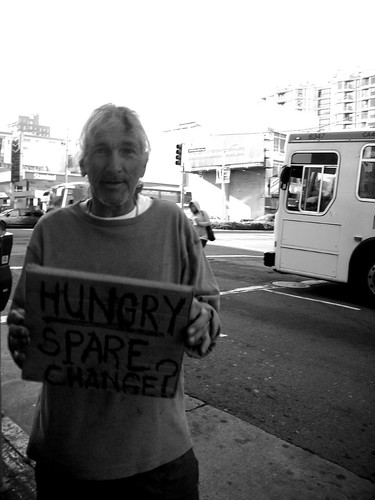 People often say the homeless, mentally ill or disabled are not "entitled" to the same daily wage as others. I invite anyone who thinks that you do not have to work to be homeless, or to obtain social security benefits to sit in a social security office for an hour and observe people. Or check out my blog of my experiences from my yearly street retreat.
Try collecting enough cans from garbage cans to pay for one meal or panhandle $20. Then you will know just a portion of the work that the homeless do on a regular basis. Then imagine accomplishing any of this without a good nights sleep and a sore aching body from lying on a hard concrete bed.
Often the people who are making the smallest amounts of money in the United States are the same individuals who face discrimination each day. How is it fair that those who are doing the most labor intensive jobs, at the lowest hourly rates are also the ones who are experiencing the additional strain of discrimination? Think of what a fair rate of pay would be for the back breaking work of picking strawberries everyday or for unloading a moving van. How much extra should we also pay for the social stigma and discrimination we also make these same workers endure?
Perhaps if people had to pay those they discriminated against they would stop discriminating. But, often those who are trying to rise above poverty or opression often oppress others. This is a lot like the complaining of those who had worked the longest. Is there any wordly way out of this cycle of abuse?
It seems that nothing short of total economic reform in addition to providing daily protection for all is needed. While this may seem overwhelming, we can work one organization, one employer at a time or one city or state at a time.
We need to become people who are honest about our power, honest about our part in economically keeping others down and the ways that we stand in the way of others having their fair wage. Then we need to hire others as we are able, advocate for better daily wages for all and for equal employment opportunities.
Lectionary Cycle B: Proper 20A/Ordinary 25A/Pentecost +19
Subscribe to:
Posts (Atom)