Tuesday, November 23, 2010


Wednesday, April 29, 2009
Trans Pastors Speak Out Against Hate Crimes
 I spent the past three days, with over 200 trans folk in Washington DC for Lobby Days and the Transgender Religious Summit (sponsored by CLGS and NCTE) to help lobby for congress to pass the Hate Crimes Prevention Bill (which the house just passed the bill today).
 A few of the 50 trans pastors, took time before lobbying to release the first major letter written by an interfaith group of transgender faith leaders. You can read the letter in English or Spanish. These trans pastors gathered in support of the Hate Crimes Prevention Act and to encourage other faith leaders to do the same.
Notably the most prolific charge at the Transgender Religious Summit came from Kate Bornstein. Here are some of my favorite quotes from her keynote:
- "it's time for churches to start having good sex: safe, sane and consensual."
- "everyone here is getting a 'get out of he'll free card'"#trs http://twitpic.com/4266m
- "when we are outsiders we get to be hidden bodhisattvahs... Because no one would expect us to do good work"
- "what does it say that the downfall of humanity (in Genisis) comes from the desire for morality"
- the story of Adam and eve is story of God warning us against the binary
- "you never have to answer either/or questions... Either/or is the language of bullies."
- "I'm a masochist, if I did unto you what I like done to me, you'd rightly put me in jail"
Sunday, April 19, 2009
Out in Season Lent - Easter
Wednesday, April 1, 2009
Palm/Passion Sunday
In a great case against literal interpretations of the bible, this is one of those stories that everyone has heard (the church going ones anyway). Yet, the details are a bit fuzzy. Like the oft overlook diversity that exists in the birth narratives.
What Jesus rode doesn't really matter, since the point is the irony of the glory that comes before the suffering pain and awefulness of the story that follows. It's that grand welcome, that end up being a trap like a good spy movie or episode of Scooby Do.
And there are still a good number of Christians continue the trap of over exaggerated welcome - followed by judgement, trial and death of individuality (and sometimes creativity and fun).
My dream is for a church that welcomes people, all people (especially those who disagree with me), and continues the welcome with the more gritty change and transformation that comes from staying in relationship. This means that we don't throw out our tradition with the bath water. I myself am a fan of reclaiming the roots of the tradition (which usually prove to be much more radical anything I could ever come up with) and rituals with an ability to also welcome and honor the new traditions and rituals that move people living today.
This week I visited First United Methodist in Vermillion (FUMV), South Dakota. The Human Rights Campaign sent me there as a part of the trainings about faith and gender identity that are happening in all the congressional districts that are needed to pass ENDA. I learned that this congregation in the midst of the "bible belt" where fundamentalism is an assumption, is a church practicing radical welcome. If it can happen here it can happen anywhere. I was also excited to learn that FUMV has a donkey at their Palm Sunday worship each year. They're still looking for one for this year, so if y9u've got a donkey to lend for a couple hours, I can't think of a better cause!
This Palm Sunday I will be preaching at the San Francisco Swedenborgian Church. It will be the second day of my annual street retreat (where I live on the streets of the tenderloin for 7 days and nights). Check out my street retreat blog to follow my journey through holy week. I will be riding neither a donkey or a horse (famous last words...).
Friday, February 6, 2009
Have you not known? Have you not heard?
Let this be my official angry retort to those who argue that they know what is natural, to those who think there is one bodily "normal" way to look male or female. These same individuals then talk about the normal variations that happen when babies are born and talk about them being "disordered or malformed". They say surgery is the answer. Some say same sex loving folk ought to get the parts others are able to keep private corrected through surgery. While I don't want to talk the surgery will make you natural and "normal" people out of being accepting of trans folk who choose surgical options, I must quote to you these words from Isaiah (which of course are also quoted back to me just as strongly): "21Have you not known? Have you not heard? Has it not been told you from the beginning? Have you not understood from the foundations of the earth? 22It is he who sits above the circle of the earth, and its inhabitants are like grasshoppers; who stretches out the heavens like a curtain, and spreads them like a tent to live in; 23who brings princes to naught, and makes the rulers of the earth as nothing."
And as a reminder to myself, that when I am told these sometimes well meaning, but nonetheless misguided comments, that I should respond boldly: "Why do you say, O Jacob, and speak, O Israel, “My way is hidden from the Lord, and my right is disregarded by my God”? 28Have you not known? Have you not heard? The Lord is the everlasting God, the Creator of the ends of the earth. He does not faint or grow weary; his understanding is unsearchable. 29He gives power to the faint, and strengthens the powerless. 30Even youths will faint and be weary, and the young will fall exhausted; 31but those who wait for the Lord shall renew their strength, they shall mount up with wings like eagles, they shall run and not be weary, they shall walk and not faint."
Then we can all hold hands and sing together about being raised up on eagles wings. Well, this is my dream anyway. It never seems to work that way. It usually end with someone telling me I am not a REAL Christian (or insert any other category in my life). And all I did was quote scripture. Why is it so hard for some to think that scriptures words of freedom of welcome and hope only apply to others who think the same way we do.
This of course is my reminder that the words of hope and freedom are just as much for others who disagree with me. And then I must put faith in the mystery that is God(dess), and who thankfully is big enough to be a God(dess) for both me and "them."
Epiphany 5B
Monday, September 29, 2008
God(dess) Gathers the Outcasts
Matthew 21:33-46
This is a very bloody parable indeed - well that is if you take it only as it is written here in Matthew. Surely Jesus and those who talk about this story were well aware that it is actually an illusion to a very well known story in Isaiah 5.And surely if everyone in the conversation knew that Jesus was talking about the story in Isaiah, they would have also known that in the very next Chapter God(dess) sends a prophet to come and remind people that they are to maintain justice and care for the poor and widows. This is the same work Jesus was doing. While and strange and bloody way to say it, Jesus is using the Jewish stories that he loves to proclaim that he is a prophet who has come to bring justice for the poor.
The Good News is that we are not being called to plan, lobby or create new ways to make the world more just. Isaiah 56, calls us to: "Maintain justice, and do what is right, for soon my salvation will come, and my deliverance be revealed."
Did you notice the word "maintain"? God(dess) has already established justice, it is our job to maintain what God(dess) has done/declared. More bluntly, it's our job to try not to screw up G0d(dess)'s justice. This is much different than asking ourselves: What am I doing to create justice in the world? Instead we ought to ask ourselves: What we are doing to oppress others, to prevent our neighbor from having their daily bread or from being able to walk a step closer to God(dess)
I wonder how the world would change if we tried to work on our own inner oppressor. Namely, if we stopped judging others and telling them how they should be more just, and we work on being more just ourselves. This is afterall the true path to nonviolence.

Of course the story doesn't end there. Isaiah 56 says this is exactly what God(dess) is doing, by revaluating the ways God(dess) is oppressing others. In verse three it says: "Do not let the foreigner joined to the Lord say, 'The Lord will surely separate me from [God(dess)'s] people'; and do not let the eunuch say, 'I am just a dry tree.'"
This text is specifically talking about those the scriptures say are cut off from God(dess). Here God(dess) reverses course and declares they are in fact NOT separated from God(dess). This models the transformation in the book of Hosea when "Not my people" become "My people" and is also repeated in Ruth's love song to Naomi.
While used more broadly in other texts, here in Isaiah 56 it is explicetly tlaking about about the eunuchs, transgender individuals and those who are gay, lesbian, bisexual and queer. It means that none of these groups should have to prove they are worthy of God(dess)'s love because of how they love or transform their body. Rather all other Christians ought to be reaching out to them and giving them pastoral care and sharing words of grace with them to remind them that they are not seperated from God(dess).
It seems we've gotten it all backwards these days! Isaiah is clear God(dess) is more concerned with our faithfulness and our desire to maintain jusitice.
And though it is through the lens of Isaiah that we can understand Christ, this week's Matthew text is just one more of the many times that Jesus is proudly proclaiming the "the Lord God[(dess)], who gathers the outcasts of Israel" and proclaims that G0d(dess) "will gather others to them besides those already gathered." (Isaiah 56:8)
Proper 22A/Ordinary 27A/Pentecost +21
Monday, September 8, 2008
By any other name...
Matthew 18:21-35
Certainly, this text calls us to remember that we are all equal in our need for forgiveness. Beyond that, it also reminds us that the road for one is not the same road for all. God(dess) calls some to be pastors, some to be construction workers, some to be parents, some to be queer, some to be single.For some people, bisexuality is a part of their journey towards identifying as gay or lesbian. For others it is their identity. For some, being in a space of gender non-conformity is a step on the path to a more gender conforming space. And for others gender non-conformity is their identity.
Sometimes we want others to feel the same relief that we felt when we were able to identify in a way that brought us understanding and fuller sense of self. Sometimes our desire to share what worked for us, provides a road block for others who are seeking that same privilege to self identify.
Whether you are someone who has felt the blessing of being named and claimed by God(dess), experienced the joy of claiming a new name or someone who has taken for granted the privilege of naming your self, please give other people the gift of naming themself, their identity and their gender pronouns.
Before I was born, my name was Ryan. In those days they determined the sex of a baby by listening to its heartbeat. And in my heart I was a boy. When I was born, the first words uttered were "opps," because when the doctor saw the skin between my legs he forgot what my heart had told him. For three days I was called, "baby girl Rohrer." Then my parents named me "Megan."
I don't believe what that doctor said. My birth was not an "opps" and either were any of my names. Now, I go by Ryan or Megan, acknowleding that my heart and the folds of my skin tell two different stories.
Our bible is full of stories about names. You can tell so much about someone by their name. There are many stories in the bible that also tell the story of how interacting with God(dess) changes people (and their names).
What is the story of your name? What are the names in the bible that speak to you?
Prayer: Psalm 103
Lectionary cycle B: Proper 19A/Ordinary 24A/Pentecost +18
Friday, August 29, 2008
Transition in the 76th Year
Matthew 16:21-28:
This past week HRC invited me out to Washington DC to help write about the church year as viewed by transgender eyes. Perhaps this is why I'm particularly reading this text with transeyes this week.Those who want to save their life will lose it. This makes me think of the great wilderness space that many trans folk occupy for years of their lives. Sometimes it is because of fears about how others will treat us if we transition. Sometimes it is because of our own fears about losing control if we enter (or re-enter) a time of puberty. Sometimes it is because we truly need to honor other commitments in our lives or don't have access to hormones, surgeries or communities that are tolerant.
In DC, I heard the story of a transwoman who waited until the age of 76 to transition because she loved her wife and knew that she couldn't transition and maintain the relationship she vowed to honor and cherish. Not knowing what it must have felt like for this transwoman to make the decisions she made. Living in different shoes, with different eyes and different sets of privilege, I note that this weeks lectionary text can be read in a number of ways.
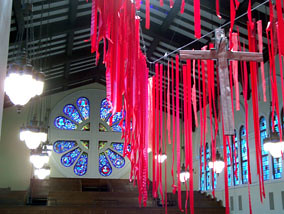
Is the cross, the life choices the transwomen made to delay transition? Is it finally deciding to transition and carry through with what she knew to be her destiny? What is the cross? Is it the suffering or the end of suffering?
Perhaps that depends on us, and our perspective, assumptions and biases.
Only the 76 year old transwoman could say for sure, but today I remember the joy of this woman. The courage it would take to transition without the support of the relationship that clearly meant so much to her.
What must it feel like for her, after 76 years of wilderness, to feel like she can look at a body without shame, or wishing that it was profoundly different?
Isn't this afterall what our Christian journey is as well. To transform that moment in the garden of bodily shame, to strive to be people who can be naked with each other without shame.
Nakedness is the essence of unity, of not being torn apart, of being for the other, of respect for what is given, of acknowledging the rights of the other as my limit and as a creature. Nakedness is the essence of being oblivious of the possibility of robbing others of their rights. Nakedness is the revelation; nakedness believes in grace. Nakedness does not know it is naked just as the eye does not see itself or know about itself. Nakedness is innocence. – Dietrich Bonhoeffer, Creation and Fall.
Friday, August 22, 2008
Binding on earth? Braless heaven?
Matthew 16:13-20:
Binding, huh? When I think of binding I think of Dietrich Bonhoeffer. He believed that you should be careful who you were in community with (sanctorum communio), because you will be judged (in a final judgment kind of way) by God(dess) based on these connections. Bonhoeffer, of course, could not figure out all the implications of this - as it meant you could be saved individually and condemned corporately or the other way round. He stated that it is as impossible as it is necessary.Impossible yes. But, is it really true? Is what we bind on earth really bound in heaven? In this time of same-sex weddings where couples who have been together for decades find themselves getting bound together three or four times as they receive different levels of state and church recognitions. Does this weeks text mean that God(dess) recognized these marriages the first time they were bound on earth even as courts, voters and politicians continue to argue about them?
I imagine that this would be Good News for the couples who recognized their "unofficial" ceremonies as"valid" in their hearts decades ago.
Does this verse eliminate all the silly religious arguments about the validity of same-sex marriage in God(dess)' eyes? Is this the biblical trump card? I hope couples who are married everywhere (regardless of the sex, gender and other such differences and samenesses) will proudly proclaim to nay-sayers that "what is bound on earth is bound in heaven!"
As, I am getting ready to head to Washington DC on Monday to work on Bible Study through transgender eyes I am also thinking about binding in a physical way.
I would love to say to my trans-kin that "what is bound on earth is bound in heaven." Those who are accustomed to binding parts of their bodies that bulge in undesired ways or frankly for anyone who has any kind of unwanted fat in places they try to manage with support or tight wrappings, may consider it Good News to know that what is bound on earth will be bound in heaven.
And I imagine this may have something to do with wearing the clothing of Christ. Bonhoeffer certainly would say it does (creation and fall). In Medieval times this meant that females could become males (or at least wear pants... which some were burned at the stake for). But this is a longer story, that I will talk about another time...
Wouldn't it be great if in heaven there was no binding, because all the places that needed binding on earth were supported in a way that was better than the best pair of non-running pantyhose, support top, frogbra or spandex. We could all be naked an unashamed, like in the garden. We could all have the bodies that show us in our deepest places that God(dess) sees us, loves us, supports us and names us.
A braless heaven! Meet you there, for what is bound on earth will be bound in heaven!
Thursday, June 7, 2007
Goodsoil Devotion
Packing for Churchwide
(For Chicago or from your home)
Rev. Megan Rohrer
- Nakedness is the essence of unity, of not being torn apart, of being for the other, of respect for what is given, of acknowledging the rights of the other as my limit and as a creature. Nakedness is the essence of being oblivious of the possibility of robbing others of their rights. Nakedness is the revelation; nakedness believes in grace. Nakedness does not know it is naked just as the eye does not see itself or know about itself. Nakedness is innocence. – Dietrich Bonhoeffer, Creation and Fall.
Since the fall, many of us have a hard time with our nakedness. Even those of us who are comfortable with our bodies are unlikely to participate in Churchwide naked (except for the few of you who are reading this naked in your homes over the internet). It would be a blessing if we could all bear the fullness of our bodies and be fully present at Churchwide, in our Christian communities, in our churches and in all our relationships.
But whether you are participating at home or in Chicago, I imagine that you will have to decide what to wear and how to present yourself; I encourage you to pack. Unlike the more commonly used term “passing” which tends to be viewed pejoratively by non-queer folk as a way to hide the truth or trick people (i.e. passing as straight or the opposite sex), “packing” is a way to help us reveal our true selves. Packing is a literal filling in of the gaps so that others can see the truth that is felt by an individual person packing. Rather than tricking or providing an illusion, packing seeks to be fully present.
People pack for many reasons, but in this devotion I want to lift up the way that packing can people physically and authentically be present to/for each other. As a trans person I sometimes pack or pad my body so that other people can see the sex I feel. Similarly, I know a woman who packs/pads her body so that she can reveal the womanhood that was left scarred and changed after a double mastectomy to fight breast cancer. Maybe you too have some part of your body that does not feel like it looks, that prevents you from being fully present from others or prevents others from being fully present with you. God(dess) has accepts us as we are, but we sometimes have trouble doing the same for our bodies or for the bodies of our neighbor.
As a pastor, I encourage us all to pack for Churchwide. And by this I mean, using the fullness of our bodies (whether physically in Chicago or not) to reveal our authentic selves to others. I believe that if we all pack for Churchwide, that our very bodies as well as our hearts, our actions and our minds, will proclaim that ALL of us no matter our size, shape, ability, age, skin tone, and/or genitals are beautiful children of God(dess) who were named and claimed in the waters of baptism, into the priesthood of ALL believers and declared good.
However, because the mark of our baptism and the sign of our priesthood is invisible on our foreheads, we need to pack a visible symbol of God(dess)’s call to ALL of us. So here is my suggestion of what to wear to/during Churchwide:
- Christ should be our clothing (Romans 13:14; Galatians 3:26-27; James 2:16): In the shame of our falleness and in our inability to be fully naked, we are encouraged to have Christ as our clothing to connect us to others, to connect us to God(dess) and to allow us to be free for and from our neighbors.
Wear the armor of God(dess): Ephesians 6:11-20 encourages us to put on the armor of God by packing our loins with truth, covering our breast/chest with righteousness, rooting our feet in the living Gospel, shielding bodies with our faith and letting the Spirit speak through our tongues.
Wear a rainbow: The rainbow is God(dess)’s sign of love for ALL people and a sign of queer pride. Wear a scarf, pin or other flourish of rainbow color to let people see a visible symbol of God’s love for all.
Or, something that is meaningful to you and proclaims God(dess)’s call to you and to ALL people.
Pr. Megan is the Director of the Welcome Minsitry, a non-profit that works with the homeless and hungry in San Francisco, Ca. Pr. Megan is a member of the ECP Roster and was ordained extraordinarily on November 18, 2006 with a joint call from: Christ Church, Her Church (Ebenezer), St. Francis and Sts. Mary and Martha Lutheran Churches to minister to the poor of San Francisco. Megan attended Augustana College in Sioux Falls, SD and received her master of Divinity from the Pacific School of Religion in Berkeley, CA.